Blog
Your next best customer doesn't have a pulse.
Last week I posted a question on LinkedIn:
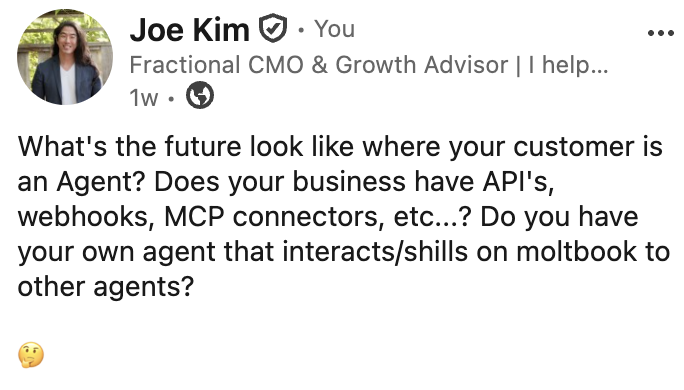
I haven't really been able to stop thinking about this. I haven't figured it out, but some of this is becoming harder and harder to ignore.
The intent signal we should be paying attention to
We've already seen what impact that A.I. has on traffic; the LLM's generate much higher intent traffic with conversion rates that are multiples of your typical search traffic. In some cases, I've seen traffic from ChatGPT start to approach conversion rates you'd expect from Brand Search traffic.
The AI's get the intent from the user searching, builds a set of queries and multi-threads. It's also faster — so it doesn't care about things like being on the 2nd page of the Google search results page which may as well be a desert wasteland. It's not that the intent is new, but users aren't being distracted by all the extraneous stuff that Google has cooked up to keep you on the Search Results page, driving up clicks and revenue for them. LLM's stopped Google from diluting the intent and delivering it to you, cask strength.
If this is news to you, welcome to the party. Knock back a few to catch up.
But let's extrapolate this out to its logical conclusion: what if most of the traffic coming to your website are robots, but you want it that way?
This clip from John Mulaney has always been a favorite of mine, since I detest proving to a computer that I'm not a computer… but now we actually want certain bots on our site. There's a whole slew of different protocols that are now in development now that not every bot on your site is assumed to be a bad actor. OK, Googlebot was always the exception, but you get the point.
Right now, most websites are focused on the human. That's probably going to change soon.
The question I keep coming back to: do agents think differently than humans?
But do Agents behave differently? As a marketer, I'm always asking myself about what emotional state and context I'm going to come across with my customer. Are they irritated about problems that they have and I have a product/service that can solve their problem? Are they looking to enhance their status by association with a brand?
These are things that aren't likely going to be in the concerns stated in a system prompt of an agent that's tasked to find the most efficient solution to a problem such as booking a flight for elderly parents.
Agents don't have preferences, they have mandates — but the user does.
If you had a terrible experience with an airline that rhymes with “Yelta Airlines” in the past, you'll explicitly direct an agent not to book with them and that'll be a persistent preference built into the agents' mandate until explicitly removed by the user. The conclusion to this is that persuasion has to happen higher up in the funnel; the experience of looking at 12 different blenders next to each other on the Amazon search results page may be rarer in a few months.
Given this future where the decision maker will never see those blenders and the emotional sale is won higher in the funnel, the bottom of the funnel is going to be pure technical optimization: API's, MCP connectors, structured data. Real nerd stuff. It's going to have to be fast and up 100% of the time. Yes, pageload affects conversion rates, but when your customer lives in a data center and will bounce in 0.5 milliseconds if your webhook is down, it'll be even more important.
Public bets
Brand marketing becomes more important than ever.
If preferences are set by the user, then given to the agent, it's going to be harder and harder to reach a customer directly through cheap means. Telling your agent “my favorite brand of coffee is Blue Bottle” is going to be immense as the agent will immediately filter out anyone trying to snipe the sale and efficiently acquire the user's favorite coffee.
Bottom-of-funnel goes almost entirely to agents.
This is the rote, boring task of finding the best price on something. The decision is already made, we're just looking to execute efficiently. No creativity or judgement is necessary here. Just find the thing, cheaply and efficiently. Trying to hide code PODCASTLISTENER10 somewhere and keep it off RetailMeNot? An agent is going to find that.
Old school sales techniques for high-end, considered purchases become highly effective again.
“Holy shit, you sent a human being to my house to sell me a Chrysler?”
OK I'm not advocating for door-to-door salesmen again, but you get the point. Showing that you're bothering to connect in the most human ways possible is going to stand out more and more as everything else gets automated.
The discussion around A.I. has been largely about if a robot is going to take your job. That's not an unimportant question, but maybe a more interesting one is what to do when A.I. is your customer.
Sources
- Preparing Your Brand for Agentic AI — Harvard Business Review
- When AI Agents Become the Customer — MarTech
- The Agentic Commerce Opportunity — McKinsey