The Austrian Defense of Marketing · Part 3
Value Is Invisible. So Is Marketing.
When things get tough, marketing is the first budget cut. What looks like discipline is usually a measurement bias — and the value you destroy is real even when it's invisible.
In the last piece I argued that most companies are central planners — substituting internal plans for the market's signal, then wondering why the plans miss. There's a corollary worth naming directly.
When things get tough, marketing is the first budget cut. Marketers are the first laid off. Founders see this as discipline — making the hard call, tightening the belt, focusing on what matters. I'm a marketer, so you can take what follows with a grain of salt. But I'm going to argue that what looks like discipline is usually a specific kind of measurement bias, and that the value being destroyed when you cut marketing is real even when it's invisible.
That word — invisible — might raise an objection. Marketing being invisible sounds wrong on its face. You see ads everywhere, billboards on the freeway, sponsored posts in your feed. But the visible parts of marketing aren't the parts that create lasting value. Ads are what marketing looks like. Brand is what marketing does. The two are easy to confuse, and most companies confuse them constantly. The value being created or destroyed when a budget gets cut isn't the visible activity. It's the slow, cumulative thing the visible activity is supposed to be building.
Two thinkers separated by ninety years can help us see why.
There's a famous WWII story that shows exactly how measurement-led decisions go wrong in this way.
Wald's Bombers
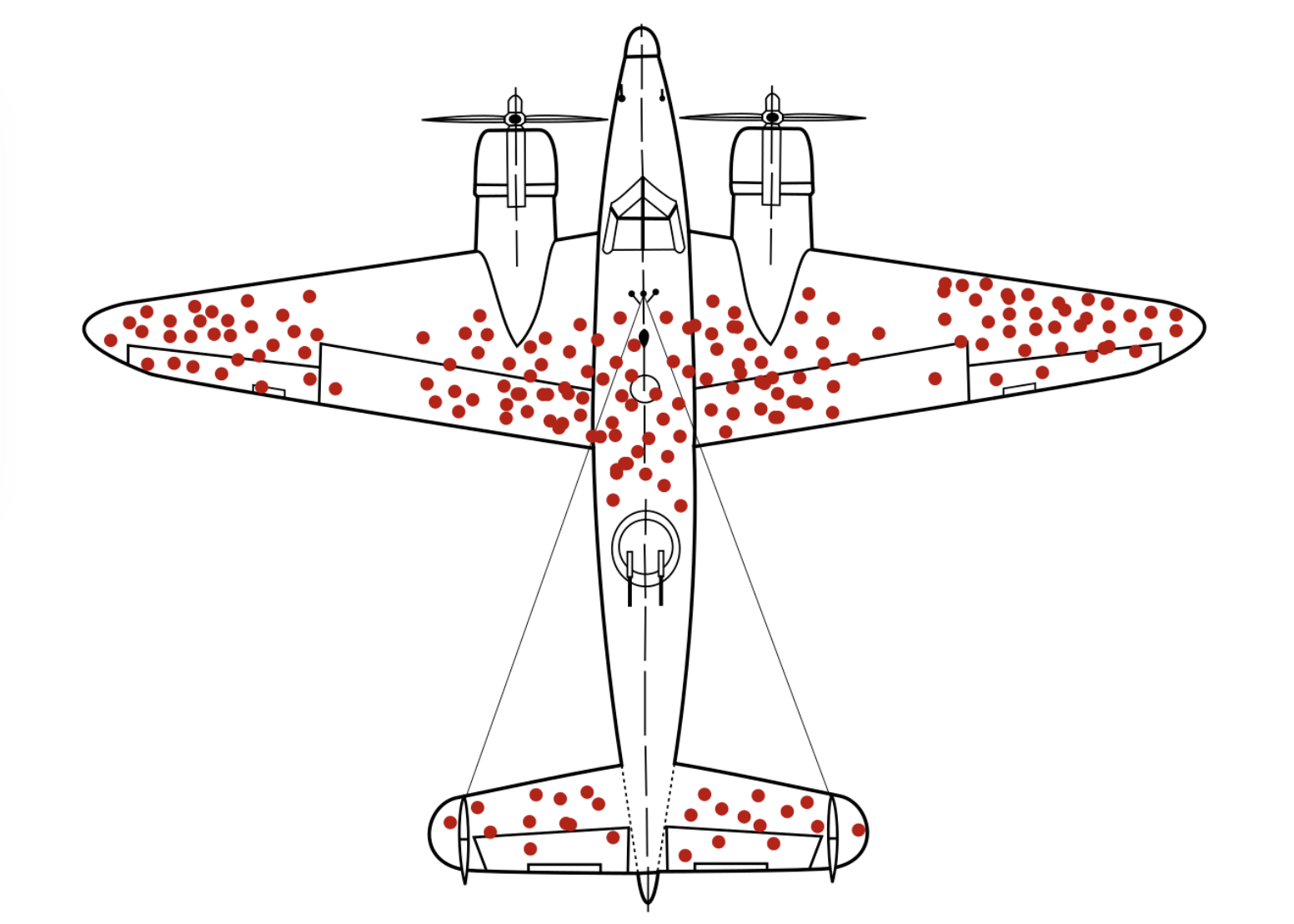
During World War II, the Allies were studying bombers that returned from missions, looking at where the bullet holes were concentrated. Engineers initially proposed adding armor to those areas. Abraham Wald, a mathematician working with the U.S. Statistical Research Group, pointed out that they had it exactly backwards. The bullet holes they were seeing were on the planes that made it back. The planes that got hit in the engines, the cockpit, or the fuel lines were the ones that didn't return — and weren't in the dataset at all. The armor needed to go where there weren't any holes. Classic survivorship bias.
The benefits of marketing are often difficult to measure. This is why Google Ads and digital marketing were such a boon to the industry when they came into vogue in the 2000s — the idea that you could directly track customer behavior and calculate ROI was a novel ability that propelled Google to its current multi-trillion dollar market cap. Eventually the novelty wore off as marketers came to understand that performance ads are just another interaction in the broader funnel of customer acquisition.
The classic saying still holds: I know half of my marketing is working. I just don't know which half.
Marketing is fundamentally a wicked problem. Nothing has really changed, even though we'd like to think it has. Which means the data we can measure is the bullet holes on the bombers that came back. The data we can't measure is everything that didn't return.
Bastiat & “That Which Is Seen, and That Which Is Not Seen”
Frédéric Bastiat, while not strictly an Austrian economist, laid down some of the foundational ideas the Austrians would build on. Most relevant here is a short parable about a broken window.
A shopkeeper's son accidentally breaks a window. The shopkeeper's friends console him by pointing out that the money he now has to spend on a new window is good for the glassworker, who will spend it on bread, and the baker will spend it on shoes, and so on. Money circulating in the economy is a good thing. Bastiat's response is that this counts only what's seen. What's not seen is everything the shopkeeper would have done with the money if his window hadn't been broken — the new shoes, the books, the savings against a lean season. The window already produced its value. When it was broken, that value was destroyed, and additional resources had to be expended just to recover what already existed.
This is Wald's bombers, ninety years earlier. The seen data — the glazier's new income, the bullet holes on the returning planes — is real, but it's not the whole picture. The unseen data — the suit the shopkeeper would have bought, the engines on the planes that didn't come home — is what actually drives the right decision. The good economist counts both. The bad one counts only what they can point at.
Apply this to a marketing budget cut. When a CFO cuts marketing in a tough quarter, the savings are visible. They hit the P&L next month. Everyone in the room can point to them. What can't be pointed to is everything those marketing dollars would have built.
What Is Your P&L Hiding From You?
Here's a great example from one of my favorite marketers, Rory Sutherland.
Five Guys throws extra fries into the bag whenever you order a cup. Why not just make the cup bigger so they're not rolling around in the bag? Because the customer disproportionately values the extra fries they're given. It's a gesture of goodwill that signals hey, we're not stingy about potatoes at your expense — we want to make sure you enjoy your experience.
On the P&L, a CFO would simply ask: why the hell are we using so many potatoes? We don't charge more for those. Cut the expense. Stop with the baggie fries.
What the CFO is missing is the experience a new Five Guys customer has when ordering — the surprise and delight of an extra handful of crispy potato treats.
How do you measure customer goodwill? Is it something that can be quantified? Would a customer even be able to tell us their attitudes toward Five Guys? Is it something you could A/B test to measure, specifically, the lift of customer goodwill? What specific level of offense does extra fries cover?
Dumb questions to ask, in my opinion.
Now some less stupid, but very difficult to answer questions: How does this affect Net Promoter Score? How is Customer Lifetime Value affected?
These are questions I've always wanted answers to as a marketer. They're notoriously difficult to acquire. Customer Lifetime Value literally takes entire customer lifecycles to measure the impact of.
And the fact that these questions are hard to answer is precisely why founders cut marketing first. Not because marketing isn't valuable. Because the value is hard to point at — and the cost is right there on the spreadsheet.
So What Do Marketers Actually Build?
Outside of your CFO's favorite metrics, what should marketing actually be building? What are the hidden assets that don't show up on the P&L?
Brand Recognition & Affinity
This is unseen on the P&L. There's no line item for “the probability that we come to mind when a buyer is ready to spend.” But it shows up in inbound demand, in close rates, in the cost of acquiring the next customer, on a horizon of years rather than quarters.
From brand assets, creative, copy, and every customer touchpoint, a marketer makes a business recognizable to its target customers. Maybe your product is so good it sells itself — but if your customers don't remember the name of your business, can they recommend it to their friends? If not, that's a failure of brand recognition.
There are a million creative ways to do this — a specific brand voice, a visual aesthetic, in the right channels an aural one. This is where the smashable brand comes in. Your brand should be a ghost that haunts the customer long after the interaction you had with them.
Awareness is the easy part. Consider an unnamed Nigerian prince looking to move some funds around — 30 years and billions of emails later, everyone knows about this scam and no one likes it.
Affinity is the harder part. Awareness is easy. Increase budget, buy more ads. Whether anyone likes and identifies with the brand they're seeing is another problem altogether, and it's not one money alone can answer. The strongest brands build both. The merely visible ones don't.
And once you've got someone who knows you and likes you, there's one more thing they need before they'll actually choose you.
Trust
This is also unseen on the P&L. There's no line item for “willingness to extend us the benefit of the doubt on a missed delivery, a confusing email, a price increase.” But it shows up in retention, in resilience to mistakes, in the price elasticity of your customer base.
This is one of the biggest. I always ask two questions when evaluating marketing: do you do something that I value? If yes, why should I trust you? The second question is much harder.
Engagement is easy. Trust is hard. We've all seen the clickbait headlines and attractive people used to pull attention. But what's going to make a customer engage with your brand over and over again? Trust. The knowledge that when they engage with you, they're going to get delivered value. The product is consistent, it's delivered on time, at a price they can expect.
Luxury brands are particularly good at this. The Hyatt or Marriott in any given city is probably not the absolute nicest hotel you could stay at, but the expectation of services is predictable — it's not an Airbnb where you have to figure out the secret handshake to get inside. If you buy a belt from Hermès, it might not be made by an artisan with three generations of leather heritage, but it's not going to be a bad belt.
Trust extends in other ways too. Porsche released the Cayenne in 2002, having never produced an SUV — and that vehicle more or less saved the company. Why? Because it was a Porsche. The brand reputation preceded the actual track record on a vehicle no one had seen before. Trust let them stretch. The CFO and P&L would never have told you there was a company-saving amount of value in the Porsche brand.
Your P&L Are the Bullet Holes
There's no direct prescription, but there are questions worth asking, and asking often:
- What are we communicating to our customers with any given interaction? Is this making us more recognizable, valued, or trusted?
- What is being destroyed when I cut a cost? What's tangible and measurable? What's intangible and unmeasurable?
- Do my KPIs actually matter? Do they align with how my customers get value from us?
- What consequences would show up in 12 to 18 months if I cut all my marketing now?
These all point back to the same place. Bastiat and Wald both hit on it: as a leader, if you only count what you can measure, you're going to miss quite a bit. What marketers build, particularly Brand Affinity and Trust, are long term, compounding assets.
Cutting the marketing budget may be the right call in your specific situation. But the right call is only the right call if you've actually counted what's being lost — not just what's being saved. Most companies don't. The ones that do tend to be the ones that compound.